
 Live Radio
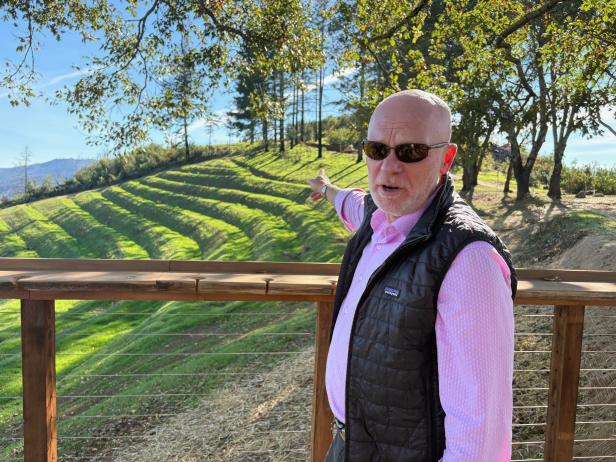 photo credit: Tina Caputo
Peter Ekman, CEO at Spring Mountain Winery, shows off a place for planting vines.
It’s been another tough year for the California wine industry.
In the face of declining demand, the California Association of Winegrape Growers estimates the state’s growers ripped out 38,000 acres of vineyards in the past year.
Some predict that tonnage for the 2025 harvest will be the lowest since the mid-1990s.
But not everyone is scaling back. Some Northern California wineries are doubling down and planting new vines.
I’m riding in an ATV with Peter Ekman, the CEO at Spring Mountain Vineyard in St. Helena. We’re winding our way through a remote mountaintop estate that’s in the midst of a massive replanting project.
“The first vineyards were planted here in 1872, so it's one of the oldest properties in the valley,” Ekman said.
After the Glass Fire in 2020, the winery decided to pull out all of the vines on the property. That’s because they suffered heat damage from the fires, and they were nearing the end of their natural life cycle.
“Two hundred-and-twenty-five acres pulled,” Ekman said. “This year we replanted 52 of them, and next year we're going to plant about 113.”
He goes on as he slows down the ATV.
“We are going to stop here for a second… [vehicle door slams] So this is possibly the best view of the entire Napa Valley you will have,” Ekman said. “That is ready for planting, as you can see. We’re going to plant this next year. We’re going to keep the terraces.”
The winery could have chosen to reduce its acreage. But instead of downsizing, it doubled down. By 2027, the winery will have replanted all 225 acres of the vines it pulled out.
Back in the ATV, Ekman tells me he’s not concerned about the recent dip in wine demand. He believes the pendulum will always swing back.
“Well, first of all, if I do what the industry normally does, which is following trends, then you will be behind—which is what the industry is famous for, right?” Ekman said. “They always react. I'm saying, screw that.”
While wineries at all price levels are seeing challenges, those at the high end of market—like Spring Mountain—are feeling less pain.
According to a recent report from Terrain—an agricultural industry analyst—the premium and luxury wine segments performed far better last year than value wines priced under $11.
“Yeah, the industry is talking about consumers abandoning,” Ekman said. “It's the young consumers that are buying cheap wines. There are no issues whatsoever in the segment where I belong with my grapes, which is the $150 bottles and up.”
Ekman said he plans to sell 90% of the grapes from this property to other wineries. And he believes the demand will be strong.
“With what's going on right now, maybe pricing is going to be stable for a couple of years. Your consumer is going to catch up,” Ekman said. “I have no problems being very optimistic about Napa Valley.”
Spring Mountain isn’t the only winery that’s feeling optimistic.
In Calistoga, Chateau Montelena just acquired a new vineyard in April. The 73-acre property—destined for Chardonnay—sits at the base of Mount Veeder in the Carneros appellation.
Winemaker Matt Crafton says the new vineyard will replace an older one the winery is losing.
“We have a large, leased property that we've been farming for the last 30 years, and that lease terminates towards the end of this decade,” Crafton said.
Rather than give up acreage, Crafton said, the winery is adding a new vineyard to keep production at the current level.
“I wouldn't say it was an easy decision, but it was the right decision in thinking about the future of the brand for the next 50 years—not the next three to five,” Crafton said.
As a bonus, Crafton said, the new property is giving the winery a chance to do some fine-tuning.
“We saw it as an opportunity to continue to evolve the style of our wine, to take everything that our customers love about the aromas, the palate, the acidity,” Crafton said. “We saw an opportunity to make those characteristics even more effusive, even brighter, even better. “
The winery is also finishing up a 10-year process of replanting its entire 100-acre estate vineyard. Crafton says it’s positioning the winery for the future.
“This family's in it for the long haul,” Crafton said.
Crafton said he believes the wine industry can overcome the current challenges—if it can get back to its roots.
And a big part of that, he said, is reminding people that wine comes from the land.

 NPR
NPR Spotify