
 Live Radio
Protesters of recent federal immigration actions have gathered across Sonoma County, condemning ICE in rallies and vigils. Many also attended the Jan. 27 Board of Supervisors meeting to criticize the board for not taking a stronger stance against any county collaboration with the agency. KRCB’s Shandra Back speaks with Sonoma County Board Chair Rebecca Hermosillo.
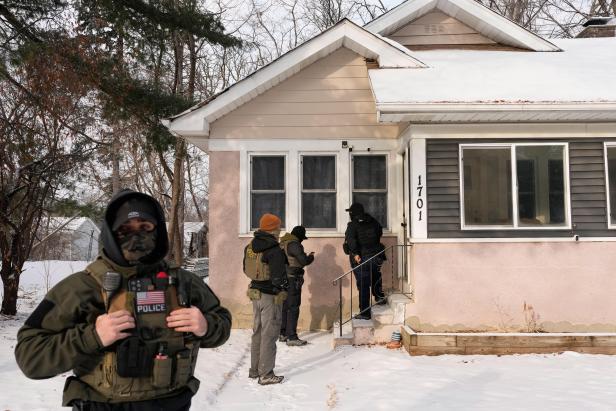 photo credit: AP Photo/Yuki Iwamura
Federal law enforcement officers knock on the door of a house on Sunday, Jan. 18, 2026, in St. Paul, Minn.
KRCB NEWS: You and the majority of the board have taken a quieter, more strategic approach rather than a loud public stance. Many constituents are calling for an explicit break from ICE collaboration to pressure the sheriff’s office. You’ve held your stance that a non‑collaboration or sanctuary ordinance wouldn’t change policy, would target the county, and that more effective work is happening through the immigrant ad hoc committee. What specific actions have been taken, and are being taken now, to protect immigrant communities in Sonoma County?
HERMOSILLO: So, this is a very nuanced issue that we are all trying to navigate. It’s very complicated. It is very challenging for me personally because I come from a mixed‑status family. That said, I know how important it is to do the right thing for the constituents — all constituents — and we’re getting a lot of feedback on both sides.
While there is a vocal group of folks asking for a sanctuary ordinance, there are still a lot of folks reaching out to us saying we’re doing the right thing for a variety of reasons. Some are maybe more conservative and think we should be cooperating with ICE more. Some are saying it’s a hard issue to navigate, but we’re doing the right thing because we’re only going to be a bullseye for ICE if we do. And I don’t want to daylight our work to the federal administration and have them come here and start taking more of our constituents.
That said, in March we formed the Supporting Immigrants ad hoc. I was the one who recommended it. Chair Hopkins agreed, and she and I are co‑chairing this ad hoc. We meet every three weeks. Sometimes we meet with the Sanctuary Coalition, sometimes we meet internally. We’ve never really had our ad hocs be that forward‑facing, but it’s an opportunity for us to connect with community and understand the needs.
We’ve trained county staff on how to respond if ICE comes to their office. We have bolstered our employees‑only areas. We are moving forward with limiting ICE’s access to county‑owned and county‑controlled properties. We have allocated $500,000 to Secure Communities Collaboration to work with nonprofits that are serving our immigrant community.
We are working to come up with an emergency response plan for when ICE comes to our community. It is currently being vetted. We just got a response from the Rapid Response Network to the draft plan. We anticipate having it rolled out very soon. It’s our job to provide public safety and public health for all of our constituents, and this is how we think we’re doing the best we can for everyone.
KRCB NEWS: It seems like the overall message from many immigrant advocates and from the board of supervisors is protecting our immigrant communities. Yet in board meetings and public comments, people are not agreeing on how that should happen. What do you think is the biggest breakdown in understanding around how to protect immigrant communities in Sonoma County?
HERMOSILLO: The biggest breakdown is really just very nuanced. It’s the word — that is it. We can operate and do everything like a sanctuary county and not be called a sanctuary county. We issued a statement last year saying we support our immigrant community, and there’s really nothing different other than the one word.
KRCB NEWS: At the Jan. 27 board meeting, we heard a lot of anger and confusion from community members who feel the board isn’t taking a strong enough stance on ICE collaboration, especially in light of what we’re seeing in Minneapolis right now. As chair, and as someone who has spoken publicly about your own background, how do those comments land with you?
HERMOSILLO: You know, Jan. 27 was a hard meeting. I’ve said that before. I come from a mixed‑status family. I understand the impacts. I also understand the impacts of when you come to the United States, there are laws that we all have to follow. And if you don’t and they’re serious, then we don’t get the privilege of staying here. My family is divided because that didn’t happen. It is very challenging, and I know people are saying comments not to be hurtful to me personally, but because they’re so driven. This is so passionate. I get it. So I try not to take things personally, but know that Tuesdays, these meetings, are very hard emotionally for me and my team because these are the constituents we serve the most. We’re very passionate about serving everyone, and it’s a hard topic.

 NPR
NPR Spotify