
 photo credit: Tina Caputo
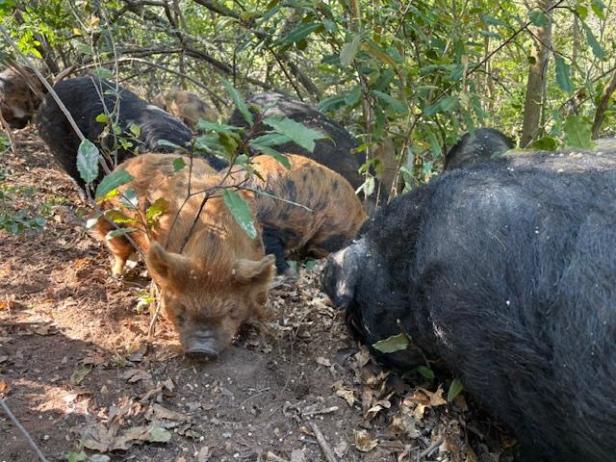
Kunekune and American Guinea hogs on the job at Hanzell Winery in the Sonoma Valley.
In the last several years, local wineries have suffered significant damage from wildfires. In 2020 alone, fires burned more than 67,000 acres in Napa and Sonoma counties and damaged or destroyed nearly 30 wineries.
In response, local vintners have adopted new strategies to protect their wineries and vineyard estates. Some have purchased their own fire trucks and hired private fire crews. Others have invested in high-tech water cannons.
At Hazell Vineyards in Sonoma, they’re using a much cuter fire-prevention method.
“We have two different pig species, and they've been used for this very thing, foraging in a forest,” said Brandon Brédo, the farm manager at Hanzell. “The American Guinea hog, which is an heirloom variety, and then a Kunekune species. And they get along great together.”
For the last seven years, Hanzell’s pigs have helped with forest management on the winery’s 200-acre estate in Sonoma Valley.
With all the recent rains, they’ve got lots of work to do. The oak, madrone and manzanita forest is green and lush, with lots of grasses and poison oak popping up beneath the trees.
But in areas where the pigs have completed their work, Brédo said, it looks like a bomb went off. The ground is mostly bare, with some tiny, crunched-up leaves scattered around.
That’s because the pigs have basically pulverized all the leaves and debris that could later become fuel for wildfires. They do that with their bodies, hooves and snouts while they’re rooting around for food.
“They love poison oak,” he said. “They love finding bay nuts and acorns, and they don't mind the hard work.”
They also love the organic pig pellets Brédo scatters for them on the forest floor.
“They'll spend most of the day finding all these little organic pellets that we throw into the thick of the woods,” Brédo said. “And in doing so, by default, their big bodies kind of break through all the forest detritus and help break it down.”
When the pigs are finished clearing an area, they move them to the next spot. Some of these animals weigh more than 350 pounds, so they’re really well suited for their jobs. And they’re always looking for snacks.
When the pigs are done foraging, Brédo and his team clean up whatever’s left and create small burn piles.
“Pigs come in, pigs go off, we go into that same area, we break things down with chainsaws and drag out all the dry and dead stuff that's not going to serve this place very well,” Brédo said. “Because after all, fire hasn't seen this land in a long time. What we're doing is we're just trying to replicate mother nature with browsing animals, and we're eventually going to put good fire back on this land.”
The result, he said, is a forest that’s healthier and more resistant to wildfires.
“From here on out, I don't see us doing it any other way,” Brédo said. “[The pigs are] really helpful. It gets us into this sort of maintenance-mindedness, this sort of caretaker stewardship piece beyond agriculture and into our surrounding forest.”
Brédo said that doesn’t just benefit the winery and the surrounding neighborhood. It also makes the animals happier than pigs in… well, you get the idea.

 NPR
NPR Spotify